Showing posts with label black. Show all posts

Sunday, 19 July 2015

So I keep finding out things about the British native pony breeds that I didn't know before.  I thought that the Dales ponies were always black or dark brown. 


Black Dales pony


 But I was wrong - this is what the Dales pony society says about the Dales' colours - "colours are predominantly black, with some brown, bay, grey and rarely roan".


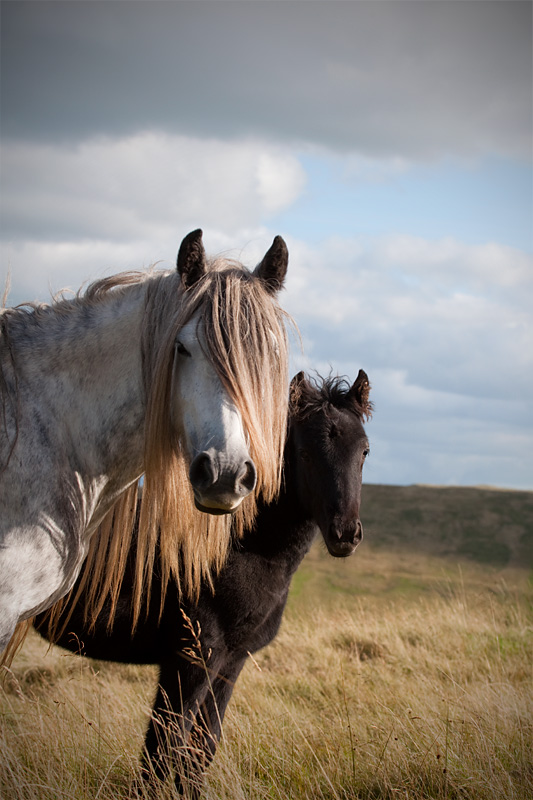
 Grey Dales pony


In fact it turns out that the blue roan and bay roan colouring in Dales is very, very rare!  It seems it was undesirable for a while and they were discouraged and nearly lost in the breed forever.  Thankfully they are gaining favour again, and the owners of the Roandale stud where I took these photos are actively breeding the roan colours.  They have a very handsome blue roan stallion (which I unfortunately didn't get a photo of as he was indoors at the time).  The Dales ponies come in bay roan and a blue roan, both very beautiful.


 Blue roan and bay roan Dales


Horse colours and how they are bred is a very interesting science - some genes are more dominant / recessive so many colours are harder to get.  Here is a very interesting chart on horse colours and how different genes effect the final colour colour chart


Bay Dales pony


I'm really enjoying this project, and all the fascinating things I am finding out about our lovely British native breeds.


**Please click on the images to see them larger.


Thursday, 21 February 2013

The many jobs of the Fell pony

The Fell ponies have an interesting history, and have had many jobs through the years.   They are native to the fells of North West England, and it's thought that the breed was established as far back as the Roman times, when they would have been caught and tamed from their natural habitat, and would have been used by the Romans for transportation of materials to build Hadrian's wall.

About Hadrians wall 


 Fell ponies on the fell


In the winter of 1492-93, 11 Kendal traders made a total of 14 journeys to Southampton with pack horses carrying loads of cloth - a journey of about 300 miles, which even on today's modern roads would be a tough journey !

 Fell ponies were even used for transporting the deceased to graveyards (they are still used today, by undertakers who conduct traditional horse drawn funerals).

Over the years the Fell pony's more domestic duty would have been as a pack pony, transporting minerals from the mines and corn to the mills. They would also have been used on farms for general duties such as harvesting, haymaking and carrying a shepherd across steep terrain.   They were also used to hunt wolves that might have been a threat to the sheep on the fells.


matching fell ponies


It is said that during the eighteenth and nineteenth centuries, Cumbrian smugglers would have used Fell ponies for transporting their contraband from the coast.   

The Post Office also used the Fell pony to deliver the mail to the most remote areas. 
During the late 1800s, trotting races grew in popularity at social events such as shepherds meets and fairs. Many Fell ponies excelled at this sport, with some Fell ponies even attracting local fame.


 Mum and baby


Hello...


ps - if you click on the photos you can see them larger (and better) :-)

Thursday, 7 February 2013

Grey Fell ponies

I have now learnt something very interesting about Fell ponies - I had always thought Fell ponies only came in black, but while up on the Fells I noticed quite a few of the ponies were grey - there were a few that were very dark steel grey and a few that were light grey.

Dark grey Fell pony

I asked the owners of the ponies if they were all Fells and they told me that they were, and that Fell ponies come in brown, black, bay and grey.  Black is the predominant colour, although dark brown used to be the predominant colour many years ago.  They also mentioned that the grey used to be quite rare, but they are now becoming more common.  They own a grey stallion.

Light grey Fell mare

It was interesting to hear about their herd and how they manage the ponies that live on the Fells.  Carole told me

"We have approx. 16 breeding mares on the fell together with young females who will in time be bred from as the older mares cease to breed.  There  are also one or two geldings which we offer for sale. The stallions (2) are  kept down at the farm as there are bridle paths across the common and it would not be safe for riders to encounter stallions and also we want to be sure  which mares are mated with which stallions.  The herd stays on the fell for most of the year.  The mares are brought down to foal in May / June and to be covered again by the stallion, after which they are returned to the fell until late October, when they are brought down in order for the foals to be weaned.  The mares are returned to the fell and the filly foals are wintered inside for the first winter.  Colt foals  (apart from any being kept as future stallions) are sold at the Fell Pony sale at the end of October at Penrith."

Grey Fell pony

Some of you readers might not have read my older posts, where I mentioned that many of the British native breeds of pony are on the 'Rare breeds survival trust' watch list.  This is a list of the breeds of British ponies that are at various stages of being endangered.  It goes from 'critical' to 'at risk'.  The fell pony is on the watch list as 'at risk', which isn't as bad as some of the British breeds, but is still not very many - it means there are only 900-1500 breeding mares in the world.  This isn't really a huge amount, so its good to see that there are several studs like Lunesdale  still breeding and promoting this lovely breed, as well as a breed society

The Fell pony society

Hopefully one day these beautiful ponies will be off of the list all together.

The RBST equine watchlist


Beautiful grey Fell pony


Tuesday, 29 January 2013

Finding the Fell ponies

2 beautiful Fell ponies

Shawn and I decided at short notice to have a week in the lovely lake district in Cumbria, as it's only 2 hours drive from where we now live, and we hadn't been there before.  This is the area that the beautiful Fell ponies originate from.  I couldn't visit that area and not try to find some feral ponies to photograph, so I did a quick bit of research to see where I might be able to find some.

I emailed the owners of Lunesdale Fell pony stud - they are Fell pony breeders that have grazing rights on Roundthwaite common, and asked if there were any Fells out on the common that I could photograph.  They said there was, and I was welcome to go to the common and look for the ponies, but they also mentioned that they may be hard to find.  What I hadn't realised was the common is really large - over 6 miles long and quite wide, including many hills and valleys.  They normally go out on a quad bike to find them and even then it can take hours !

The huge area where the Fells roam


Well, I really wanted to see them so Shawn and I (it was me really) decided to go for a drive around the area and see if we could find a way up to the common and decide if it was worth looking for them.  We drove to the area through some country lanes and into a little village.
I looked up onto the hills ahead, and guess what - I spotted some tiny black dots on the horizon.  Shawn thought they might be cows, but I was convinced they were ponies.

We stopped and asked a farmer if we could get up to where they were, and he said the best way was to go back down the road, and then up through some fields onto the ridge, and then to walk along the ridge.  So we parked the van, near the place he had pointed out and got ready to walk up.  Just then a cross looking man came out of his house and asked what we were doing, he then said the way we wanted to go up would involve walking through his field, and he told us he would not allow us to go through his land !  We were a bit disappointed, and headed back towards the first farmer.  He very kindly took us to one of his fields further along and showed us another way up to the ridge.  The field was really, really steep, and I was a bit worried as he said there was a bull in the field somewhere !

After about 1/2 hour climbing up the hill we got to the stone wall around the common and climbed over.  The ponies were right there :-)  I felt so lucky that I had found them.


I very quietly took a few photos from a distance, as I didn't know how tame they were.  They tolerated me but as soon as I tried going closer they ran away.  So I took a few more photos from a distance, then this time got closer and closer very slowly.  They let me get quite close, and I just watched them and took photos for ages.  After a while they realised I was no threat, and got quite inquisitive - quite a few of them, including some foals, came right up to me and sniffed and nuzzled me.  It was such a lovely feeling that they felt that safe with me.

 Fell pony saying hello


 Inquisitive Fell pony foal

I had a lovely time being with these beautiful native ponies, and it is great to see them in their natural setting, looking healthy and as nature intended.

Please look back for the next blog as I have lots more lovely photos, and I will be writing about Fell ponies, and their origins, characters etc

Tuesday, 25 September 2012

I want one


I was very taken with the Eriskay ponies on the Island.  I thought they would be very timid and wary of humans, so at first I stayed quite a distance away from them and kept very quiet.  I had my long lens on my camera in order to get close enough shots. 


But within a few minutes I was surrounded by inquisitive and nosey ponies !  They all wanted to know what was going on, and came over to have a look.  Even the little foals and yearlings were coming right up to me and nudging me.  It actually became quite hard to take photos of them as they kept shoving their noses into the camera lens.


  Nosey Eriskay pony

After I had said hello to them all and they knew I was a friend they gradually wandered off to graze, and occasionally popped over to say hello.

 My new friend - I want to take him home !

The Eriskay pony society breed standard says of their temperament:

"Eriskay Ponies should be placid and amenable with no signs of viciousness or aggression".

Breed standard 

This is certainly how this little herd were.  And it's why they made excellent all round, useful ponies back in the old days, when they did a bit of everything, and had to be relied on to be safe and sound for the children to ride.

Quote from the Eriskay pony society: 

"Today, Eriskay Ponies can be seen competing in all spheres of equestrianism. Members of the Eriskay Pony Society regularly take part in activities such as hunting, dressage, show jumping, show hunter, cross country, pony club eventing, team games, western riding and driving. Although they stand between 12.0 and 13.2hh they are strong for their size, have terrific stamina and can carry a light adult with ease. They also make excellent driving ponies, Lesley Cox from Cheshire has had tremendous success with her tandem driving ponies, competing at FEI level and winning regularly.
Other Eriskays make excellent family ponies, with their human friendly characteristics coming to the fore playing football in the garden with the kids, or working with special needs children as RDA ponies."


From what I saw of these lovely ponies, I would definitely recommend them as a child's or family pony ( or even a small adult like me ) :-)  


 Eriskay pony in the reeds


 Eriskay ponies in the reeds

Wednesday, 22 August 2012

Black and white

The ponies....not the photos !

A very interesting fact about the Eriskay ponies is that they are born black, but hardly any of them stay black - they nearly all go white or grey and occasionally bay.

Black Eriskay pony yearling

In the small herd that I saw on Eriskay all the adults were white or grey and the 3 young ones were black or very dark grey.


Black Eriskay pony yearling

This mare is so white she is really glowing in the sun, but her baby is really dark black. 

Mum and baby

These photos were taken in March and you can see how lovely and thick their coats are - their coats are really dense and waterproof and they are able to live out on the hills all winter in the harshest of the Scottish weather - which I can tell you is sometimes really bad, especially on the West coast !  It can get very cold, wet and windy, and very often snows.  They have quite generous tails and manes to keep out the weather.

Even though they are quite small ( 12hh - 13.2hh ) they are very strong and can easily carry a small adult ( which is good because I would like to get one some when ! )

Just on a bit of a side note -
I find it very interesting to see that even without much interference from humans these feral horses do really well - some people may look at them and think "poor ponies out on the hills with no lovely lush grass, no buckets of feed, no cosy stable or rugs and no shoes on for the rocky ground" but I look at them and see very well adjusted and happy ponies - none of them are too fat, none of them are too thin and their hooves are in excellent condition.  They don't seem to suffer from so many of the common ailments of our pampered and fussed over horses and ponies.  This sort of terrain and rough pasture suits them much more than our conditioned ideas of what is good for them.  Maybe we should more often consider what is natural to the horse and try our best to imitate this in the way we keep our equine friends at home.

Rocky rough terrain

Thanks for reading, and hope you will read the next post.