Showing posts with label white. Show all posts

Wednesday, 3 July 2013

Highland ponies and deer stalking

 Native highland ponies

 The highland ponies we saw at Glen Feshie were very large and chunky for a pony, as you can see from the photos - they are more like a draft horse build.

 Highland pony

 They have been intentionally bred to be like this, so that they could be used for their many jobs in the Highlands of Scotland.

Their strength and size would have made them a suitable mount as a war horse, as far back as the days of William Wallace and Robert the Bruce. It is said that Robert the Bruce faced the attack of the army of King Edward II, sat astride a Highland pony.

Other jobs they have had over were as pack ponies, transporting goods in large wicker panniers attached to a wooden pack saddle. They were used on farms, where the crofters used them for ploughing, forestry, and haulage. In later years, Country Estates found the Highland pony useful for bringing game and deer down from the hills.  The ponies handlers are often called ghillies and the ponies are called garrons.

This is a job some of them still do - as was mentioned in my last blog 
The ponies of Glen Feshie

Their size ranges from 13hh - 14.2hh (132cms - 148cms) but they are very very strong for their size.  It is said they can carry up to 17stone.  A full grown stag could easily weigh that much and they carry these across the hills after a days hunting.

 
White Highland pony


If you want, you can pay lots of money to one of the large Scottish estates in the Highlands and try this for yourself ( not the carrying of the stag - but joining a shooting party ! )


I would just like to mention that although deer stalking is regarded by many as a necessary part of Scottish life, I do not personally endorse it - I am against all blood sport.

 
Beautiful Highland pony


Please click on any of the photos to see them larger.

If you want to purchase my horse prints, many of them are available to buy from my website or my etsy shop


Thursday, 10 January 2013

Happy new year

Happy new year to you all - I hope you had a good time over the holidays.  

I really must get back to the blog now.  I have lots to catch up on - I already have the Fell ponies and New Forest ponies to write about, and this year I would like to visit Shetland or the Highlands to photograph them, and I also want to go to Yorkshire to photograph the Dales ponies.  Then that just leaves the Exmoor and Dartmoor ponies.  I'm not sure whether to include the Irish Connemara ponies in this project as I'm not sure whether they are British ( as far as I know they only roam feral in Southern Ireland, although they would have once been all over Ireland, and Northern Ireland is British ! )  What do you think - please leave your thoughts in the comments as I would love to hear your opinions on this. 

Just one last blog with photos on the Carneddau Welsh mountain ponies:

 
White Welsh pony mare


The wild Welsh mountain ponies might have an uncertain future, but the section A Welsh ponies, which are the closest  to the wild mountain ponies, are very popular.  There are also 3 other types of Welsh pony categories ranging in size from under 12hh to exceeding 13.2hh with no upper limit.

The Welsh Stud Book contains registration details of four "types" of Welsh Ponies and Cobs.  These types include the Section A Welsh Mountain Pony, Section B Welsh Pony, Section C Welsh Pony (Cob type) and Section D Welsh Cob.  Each Section, or type, has specific characteristics, but all retain the pony character, versatility and excellent temperament of the Welsh breeds.

Because these ponies were the hill farmers' main means of transport, herding sheep and wild ponies over rough and mountainous country, they had to be hardy, balanced and fast.  This ensured that only the best were bred from. These qualities, combined with a natural jumping ability, and the temperament of their Welsh Mountain Pony forebears make the Welsh ponies and cobs really great riding ponies and all rounders.

You can read about the breed standard and characteristics on the Welsh pony and cob website


I think this Welsh mountain stallion is beautiful and even though he is wild and a bit unkempt he really shows  where the different types of Welshies get their looks from.


Welsh mountain pony stallion


Some last photos from Carneddau - they seem to be very itchy ponies !!


You scratch my back and I'll scratch yours

Little foal in the middle wants a scratch too

Its my turn
 The stallion has to scratch his own bum !


Just one last photo - what do you think of this ?  It was an experiment, but I think I like it :-)

Welsh pony in pink


I'm really looking forward to writing the next blog - it will be about the beautiful Fells of Cumbria.  I have some great photos of them, so please come back to read it.


Thursday, 18 October 2012

cheeky foal

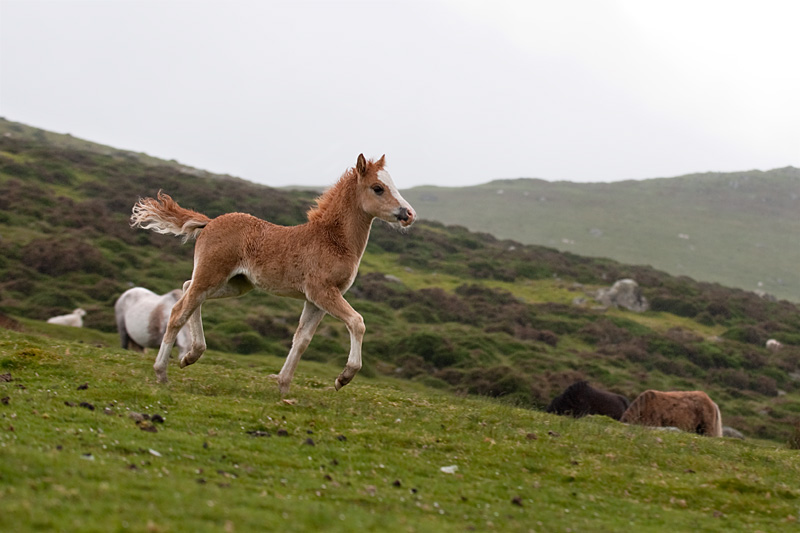
There were about 4 or 5 foals in the herd I was watching, all only a few days old.   One of them had spotted me watching him and got a bit shy.  He went and hid behind a gorse bush, so I couldn't see him.  It didn't take long for him to got curious though and he peeped his head out from behind the bush.

welsh pony foal

He kept getting shy and hiding back behind the bush, and then peeping out again, each time a little bit further.  He was being very cheeky and was definitely playing with me !  In the end he realised I was no threat and wanted to show off.  He ran out from behind the bush and started running around, keeping making glances my way - I couldn't help laughing at him - he was so cute.

practising his trot

speeding up

He ran around for a few minutes - trotting, cantering, galloping and bucking - he was having great fun, but then he suddenly got embarrassed, and ran back and hid behind his mum.

welsh mare and foal

He was still watching me and knew I was watching him.  After a while he ran off again, up and down the hill, round and round, until he got tired and ran back to his mum for a rest.

welsh mare and foal

I had the best time watching him, and he made my day.  Its amazing how he was only a few days old but was able to do all the paces and even buck already !  He was a real show off as well, maybe he will grow up to be the stallion of his own herd one day.

  
This is a lovely shot of his mum.

 wild welsh pony

Lets hope that the Carneddau ponies future is safe, and that they continue to grow in numbers, and remain on the hills.  Luckily we are now starting to realise that the wild and feral native ponies of Britain are very important and need protecting.  They are very important to our heritage, but also are very useful in land conservation.  This is a quote from a very interesting BBC news article from 2008:

“Theses mountain ponies are very special to us in Snowdonia. Not only do they contribute to our cultural heritage, the Welsh mountain ponies and their genetics has an important role to play in sustaining the diversity of plants and insects on the mountain slopes. Their grazing patterns mean that they keep vegetation low on the mountain in winter and provide a good source of food to the chough during the winter. This in turn allows the fragile habitats of the highland to be revitalized when the sheep aren’t there.”

You can read the whole article here

Article on the welsh carneddau ponies


Tuesday, 25 September 2012

I want one


I was very taken with the Eriskay ponies on the Island.  I thought they would be very timid and wary of humans, so at first I stayed quite a distance away from them and kept very quiet.  I had my long lens on my camera in order to get close enough shots. 


But within a few minutes I was surrounded by inquisitive and nosey ponies !  They all wanted to know what was going on, and came over to have a look.  Even the little foals and yearlings were coming right up to me and nudging me.  It actually became quite hard to take photos of them as they kept shoving their noses into the camera lens.


  Nosey Eriskay pony

After I had said hello to them all and they knew I was a friend they gradually wandered off to graze, and occasionally popped over to say hello.

 My new friend - I want to take him home !

The Eriskay pony society breed standard says of their temperament:

"Eriskay Ponies should be placid and amenable with no signs of viciousness or aggression".

Breed standard 

This is certainly how this little herd were.  And it's why they made excellent all round, useful ponies back in the old days, when they did a bit of everything, and had to be relied on to be safe and sound for the children to ride.

Quote from the Eriskay pony society: 

"Today, Eriskay Ponies can be seen competing in all spheres of equestrianism. Members of the Eriskay Pony Society regularly take part in activities such as hunting, dressage, show jumping, show hunter, cross country, pony club eventing, team games, western riding and driving. Although they stand between 12.0 and 13.2hh they are strong for their size, have terrific stamina and can carry a light adult with ease. They also make excellent driving ponies, Lesley Cox from Cheshire has had tremendous success with her tandem driving ponies, competing at FEI level and winning regularly.
Other Eriskays make excellent family ponies, with their human friendly characteristics coming to the fore playing football in the garden with the kids, or working with special needs children as RDA ponies."


From what I saw of these lovely ponies, I would definitely recommend them as a child's or family pony ( or even a small adult like me ) :-)  


 Eriskay pony in the reeds


 Eriskay ponies in the reeds

Wednesday, 22 August 2012

Black and white

The ponies....not the photos !

A very interesting fact about the Eriskay ponies is that they are born black, but hardly any of them stay black - they nearly all go white or grey and occasionally bay.

Black Eriskay pony yearling

In the small herd that I saw on Eriskay all the adults were white or grey and the 3 young ones were black or very dark grey.


Black Eriskay pony yearling

This mare is so white she is really glowing in the sun, but her baby is really dark black. 

Mum and baby

These photos were taken in March and you can see how lovely and thick their coats are - their coats are really dense and waterproof and they are able to live out on the hills all winter in the harshest of the Scottish weather - which I can tell you is sometimes really bad, especially on the West coast !  It can get very cold, wet and windy, and very often snows.  They have quite generous tails and manes to keep out the weather.

Even though they are quite small ( 12hh - 13.2hh ) they are very strong and can easily carry a small adult ( which is good because I would like to get one some when ! )

Just on a bit of a side note -
I find it very interesting to see that even without much interference from humans these feral horses do really well - some people may look at them and think "poor ponies out on the hills with no lovely lush grass, no buckets of feed, no cosy stable or rugs and no shoes on for the rocky ground" but I look at them and see very well adjusted and happy ponies - none of them are too fat, none of them are too thin and their hooves are in excellent condition.  They don't seem to suffer from so many of the common ailments of our pampered and fussed over horses and ponies.  This sort of terrain and rough pasture suits them much more than our conditioned ideas of what is good for them.  Maybe we should more often consider what is natural to the horse and try our best to imitate this in the way we keep our equine friends at home.

Rocky rough terrain

Thanks for reading, and hope you will read the next post.