Showing posts with label welsh ponies. Show all posts

Friday, 30 November 2012

Taming the wild ponies

“People assume they are too wild to tame,” said Mr Thomas, of Crymych, Pembrokeshire.

Read more: Wales Online http://www.walesonline.co.uk/news/wales-news/2011/06/25/happy-horse-whisperer-who-tamed-wales-wildest-mountain-ponies-91466-28938196/#ixzz2DcPU11D1
“People assume they are too wild to tame,” said Mr Thomas, of Crymych, Pembrokeshire.

Read more: Wales Online http://www.walesonline.co.uk/news/wales-news/2011/06/25/happy-horse-whisperer-who-tamed-wales-wildest-mountain-ponies-91466-28938196/#ixzz2DcPU11D1
 Welsh mare and foal

Here is some more about one of Britain's wildest pony breeds (and one of the most endangered) living on the Carneddau Hills in Wales. 

They are actually pretty wild, on alert all the time and are very suspisious of anything unusual happening around them.

While I was there I was quietly watching a group of ponies having a nap in the sun.  They were all quite relaxed, but some were still on the lookout.

 Welsh ponies dozing in the sun

   Quite relaxed 

All of a sudden, out of no where came a scary plastic bag flying about on the wind.  The ponies were all instantly awake and running from the 'predator'.

Fleeing the plastic bag

They ran for a bit then stopped to see if they were being chased by the scary bag, and when they realised that the bag was just a bag, they soon settled down again and began to graze.

An article from Wales online written in June 2011 explains how the wildness of the ponies could be contributing to the decline of them, and why the farmers who owned the ponies decided to ask Barry Thomas a local horse whisperer to help - here is a small piece from the article:

        " “People assume they are too wild to tame,” said Mr Thomas, of Crymych, Pembrokeshire.

“People assume they are too wild to tame,” said Mr Thomas, of Crymych, Pembrokeshire.

Read more: Wales Online http://www.walesonline.co.uk/news/wales-news/2011/06/25/happy-horse-whisperer-who-tamed-wales-wildest-mountain-ponies-91466-28938196/#ixzz2DcPU11D1
“People assume they are too wild to tame,” said Mr Thomas, of Crymych, Pembrokeshire.

Read more: Wales Online http://www.walesonline.co.uk/news/wales-news/2011/06/25/happy-horse-whisperer-who-tamed-wales-wildest-mountain-ponies-91466-28938196/#ixzz2DcPU11D1
 “Therefore they are not marketable, they cannot be sold, they cannot fetch a price, so the farmers cannot afford to keep breeding them.

“There are only around 200 of the ponies left on the hills of Snowdonia, so anything that can be done to save them must be done.”

After an end-of-season sale last year in which 45 of the Carneddau ponies were sold for just £430, Mr Thomas was asked to see if he could do what nobody has ever done before: tame and train a Carneddau pony.

The Carneddau Pony Society hoped the training would help increase the animals’ market value, which in turn would give the Snowdonia farmers the incentive to breed them."


 A similar thing had been done before by Monty Roberts, the American 'horse whisperer' when he had tamed and trained a wild Mustang.  Barry Thomas is actually one of Monty's students and was glad to accept the challenge.

He captured 2 of the wild ponies and brought them back to his farm.  He did succeed in taming and training them, and there was a programme filmed about it but unfortunately I can't find it to watch.  Whether it has helped with the popularity of the Carneddau wild ponies, or whether people will want to own them is to be seen, but the Carneddau ponies more domesticated cousin - the Welsh section A pony, is very popular.  In the next blog I will look at the breed characteristics and see why they are such great little ponies.

Read the whole article here


 Beautiful chestnut mare


Tuesday, 20 November 2012

Welsh ponies outsmart Henry VIII


 Welsh mountain pony

This isn't the first time the Welsh mountain ponies have been threatened with extinction.  The ponies were nearly made extinct 100's of years ago, around the beginning of the 16th century.  Apparently King Henry 8th, who had a reputation for killing anyone and anything that got in his way, demanded that the ponies all be destroyed.  His reasons for this were that they were too small - too small to carry a knight in full armour !  Luckily he didn't succeed, and some of the ponies survived. 

The Romans recognised their strength and agility though, and used them for many jobs while they were in Britain, and even took some back to their homeland .

They were also used in the 19th century by the coal miners to pull carts down into the coal mines.  That must have been a pretty miserable life for them.  Some of them even lived in the mines, staying in stalls built down there and living on hay, never seeing the light of day.

All this has made them very tough and strong, and made them into the hardy little ponies that they are today.  The welsh pony and cob society says "Bred in the mountains and wild regions of Wales for many generations, their acknowledged beauty does not mean they are merely a 'pretty toy' — centuries of 'survival of the fittest' has ensured the sound constitution, iron hard limbs and great intelligence"
 
society website

You  can definitely see they are tough and hardy little ponies, but they are also very beautiful.

 Some more photos here of the Welsh mountain ponies on Carneddau.  It started rain while I was photographing them, but they were starting to get used to me and I didn't want to leave so I carried on taking photos.  I didn't realise how wet my camera lens was getting, until I look at the photos later - you can see the photos getting more and more misty - but I actually think it gives quite a nice effect, kind of like a soft filter !


 Yearling welsh pony

This one has dreadlocks as he's loosing his winter coat.

 Yearling welsh pony


 Beautiful welsh mare


Welsh mare and foal

Even though people have recognised the ponies usefulness and adaptability during the centuries, they are still facing an uncertain future.  Some are being used for land conservation, but they are not very saleable, going for only a few pounds each at the sales.  In the next blog I will write about how a Welsh horse whisperer was bought in to try and help improve this.

Remember many of these prints can be purchased on my website or my Etsy shop


Thursday, 18 October 2012

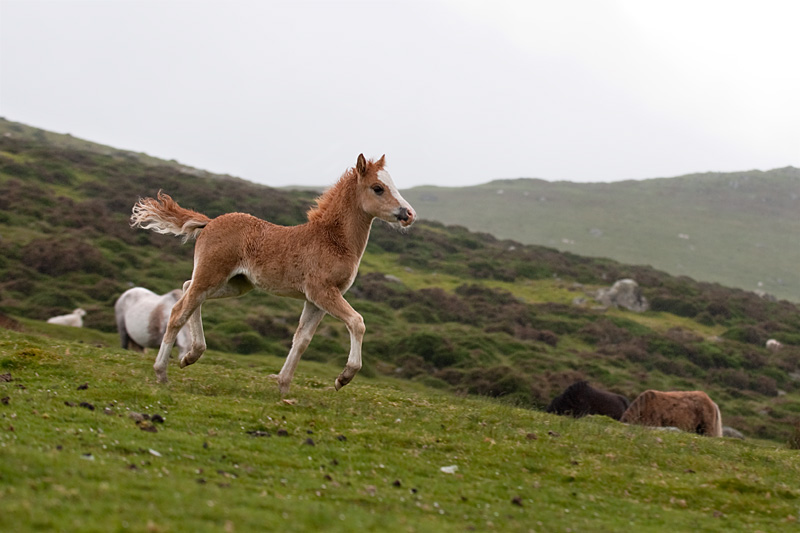
cheeky foal

There were about 4 or 5 foals in the herd I was watching, all only a few days old.   One of them had spotted me watching him and got a bit shy.  He went and hid behind a gorse bush, so I couldn't see him.  It didn't take long for him to got curious though and he peeped his head out from behind the bush.

welsh pony foal

He kept getting shy and hiding back behind the bush, and then peeping out again, each time a little bit further.  He was being very cheeky and was definitely playing with me !  In the end he realised I was no threat and wanted to show off.  He ran out from behind the bush and started running around, keeping making glances my way - I couldn't help laughing at him - he was so cute.

practising his trot

speeding up

He ran around for a few minutes - trotting, cantering, galloping and bucking - he was having great fun, but then he suddenly got embarrassed, and ran back and hid behind his mum.

welsh mare and foal

He was still watching me and knew I was watching him.  After a while he ran off again, up and down the hill, round and round, until he got tired and ran back to his mum for a rest.

welsh mare and foal

I had the best time watching him, and he made my day.  Its amazing how he was only a few days old but was able to do all the paces and even buck already !  He was a real show off as well, maybe he will grow up to be the stallion of his own herd one day.

  
This is a lovely shot of his mum.

 wild welsh pony

Lets hope that the Carneddau ponies future is safe, and that they continue to grow in numbers, and remain on the hills.  Luckily we are now starting to realise that the wild and feral native ponies of Britain are very important and need protecting.  They are very important to our heritage, but also are very useful in land conservation.  This is a quote from a very interesting BBC news article from 2008:

“Theses mountain ponies are very special to us in Snowdonia. Not only do they contribute to our cultural heritage, the Welsh mountain ponies and their genetics has an important role to play in sustaining the diversity of plants and insects on the mountain slopes. Their grazing patterns mean that they keep vegetation low on the mountain in winter and provide a good source of food to the chough during the winter. This in turn allows the fragile habitats of the highland to be revitalized when the sheep aren’t there.”

You can read the whole article here

Article on the welsh carneddau ponies


Tuesday, 9 October 2012

Finding the Welsh ponies

As part of my plan to travel the length and breadth of Britain to photograph all the British native ponies in their native environments, I next visited Wales.

After quite a long drive of about 6 hours, and after driving through some places with funny names ( one place was called Pant, which we thought was really funny due to being very immature ) we arrived at the South of the Snowdonia National park.

I hadn't had time to do much research on where to find the feral Welsh ponies, but I knew they were somewhere in the park. It wasn't until the next day when I started driving through the park that I realised it is massive !

snowdonia national park website

How on earth was I going to find the ponies ?  I asked around at some tourist information places and finally a woman found out they were near a place called Aber common and pointed to an area on the map near the top of the park.

We drove to the area but couldn't find a road that seemed to go where we wanted to go.  We eventually took chance and headed up a very steep, tiny single track road.  We got to the top and there was a car park and some paths up onto the hill, so we decided to take a look.  A man walking his dog just got back to the car park and I asked him if he had seen any ponies.  He said no he hadn't seen any ponies today, but he was a local and said they were around somewhere up on the hill or in the valley.  He said there are 3 small herds in different areas, and some had just had foals.  Sometimes he would see them other times he didn't.  I was so excited we had found the right area, and that they had foals, but I was a bit worried we wouldn't find them.

As we walked up through the gate I saw a National trust sign that said 'Carneddau' and remembered that during my research I had read about the feral Carneddau ponies, so we were definitely in the right area for seeing some proper feral ponies. 


The Carneddau ponies are in the group of Welsh ponies called Welsh section A mountain ponies, and the ones on Carneddau common are truly feral and have been here for 100's if not 1000's of years.  Welsh mountain section a ponies are on the endangered breeds list as vulnerable, although the wild ones are extremely rare.


We walked up the hill to the left rather than into the valley, and carried on a little.  After about only 1/2 mile or so we spotted the ponies in the distance - I couldn't believe how lucky we were.

We crept up slowly and quietly as they are not handled or used to humans being too close.

Feral Welsh Carneddau mountain ponies

I sat and watched them for a while, but kept my distance as they knew I was there.  I slowly crept a little closer.  One of the ponies gave me a shifty look and moved the others away a bit.  He was beautiful and strong, and had the most amazing long mane.  I knew by the way he was behaving that he was the stallion.

Carneddau pony stallion

I hung around with them for a few hours and they gradually got used to me, allowing me to get fairly close, but never too close.  I managed to get some lovely photos of them, so please read the next blog to see more photos and find out more about these lovely little rare and endangered ponies.