Friday, 11 October 2013

The Queen's favourite


Highland ponies


The Highland pony is an ancient breed, although there have at times been other breeds introduced into their breeding - including Arab, Clydesdale and Percheron to make them larger and stronger.  They have had many roles throughout history, including logging, carrying stags for the shooting parties and going to war.  


Yellow dun Highland pony


They have also been favoured by the Royal families down through the years: 

Queen Victoria talks about riding Highland ponies.  In "Life in the Highlands" the Queen describes a September day in 1842 when she and Prince Albert were the guests of the Duke of Atholl at Blair Castle: "We set off on ponies to go up one of the hills, Albert riding the dun pony and I the grey, attended only by Sandy McAra in the Highland dress. We went out the back way across the ford, Sandy leading my pony and Albert following closely, the water reaching above Sandy's knees" 

Queen Elizabeth II is patron of the Highland pony society and In 2007 she opened a full-time Highland pony stud at Balmoral.  One of her ponies won its class at the Royal Highland show in 2010.  She is also often seen riding Highland ponies around the estate.


 Mouse dun Highland pony


However even after all their popularity and hard work they are still on the watch list of British native pony breeds - they are listed as 'at risk'


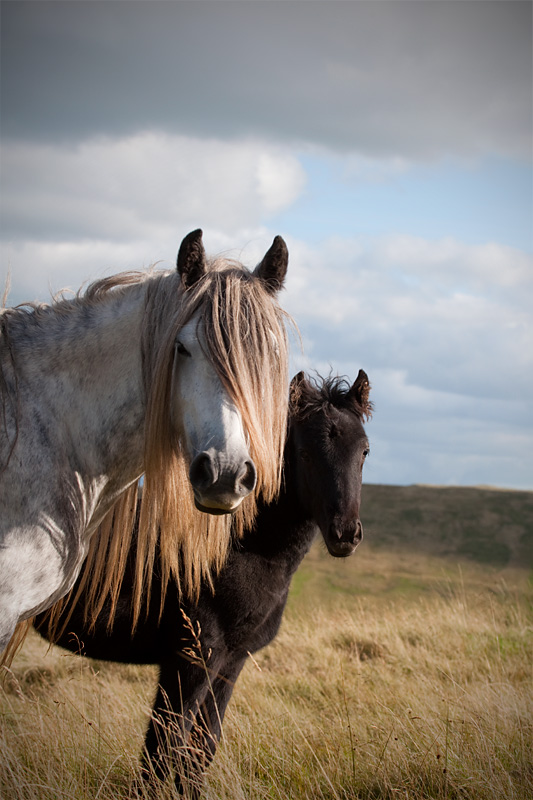
 Dark grey Highland pony


Hopefully their popularity may come back and people will realise how adaptable and fun to ride they are, even for adults, and they will be able to come off the rare breeds watch list.


White Highland pony


 Scottish Highland pony


*Please click on the photos to see them larger


Friday, 23 August 2013

What is the difference between dun and buckskin ?

Back in April of this year, we went to stay for a long weekend up near Aviemore in the Highlands.  While we were there I wanted to see if I could find any Highland ponies living feral to photograph for my British native pony project.

We found some information from various people saying they had spotted ponies on the Loch Ericht Estate, near Dalwhinnie.  The ponies are wintered out on the estates vast land, but are quite often seen near Loch Pattack.  As with all of these large estates, people are welcome to walk, cycle and horse ride on their land because of the Scottish right to roam laws, which is great.

The land where the Highland ponies might be, and Loch Pattack are at least 7 miles from any public roads, so we decided to take our mountain bikes and ride up to the area along a track.  Even though it was the middle of April, it was freezing, and there was still snow on the higher ground - we were having extremely cold weather for that time of year !

We wrapped up with lots of layers and I put all my camera equipment in my rucksack and off we set.  It was a lovely ride, the scenery was beautiful and while we were cycling I was warm enough, but as soon as we stopped I started getting cold.  Unfortunately, I only managed to shoot for about an hour before I was frozen and I had to give up, but I got a few really nice photos.


The Highland ponies when we first spotted them


As you can see there were four of them, and some really pretty colours - a dark mouse dun, a yellow dun, a very dark dapple grey and a white one.

Two of them were very inquisitive and decided to come over and see what we were up to.


Dark dapple grey Highland pony

 
Look at the highlights on this one - women pay lots of money to have hair like that !


Yellow dun Highland pony


This brings me to a very interesting question - What is the difference between a dun and a buckskin ? (my Icelandic is called buckskin on her passport, but she looks the same as this Highland pony)  Highlands are never classed as buckskin, only dun - so are they the same thing?  Actually, no, even though they can often look very similar.  It's all down to genetics.

Both dun & buckskin can be a golden/yellow/creamy coloured body with a black mane, tail and legs.  The body colour can range from a light, creamy colour to a deep, rich yellow or gold.  But they are different because each of them come from a different dilution gene on a bay base.

Buckskin comes from a cream dilution gene on a bay horse.

Dun comes from a dun dilution gene on a bay horse.

Dun horses also always have at least one primitive characteristic – a dorsal stripe, striping on their shoulders, legs and/or forehead.
 
For a more detailed explanation, with pictures to help, see this article:
 
 
You can just see his dorsal stripe in this photo.


Yellow dun pony bum


Please click on any of the photos to see them larger.


Friday, 26 July 2013

The Highland ponies lovely colours

There were only 3 ponies at this location a very dark bay, a bright bay and white, so these ones weren't that unusual.  Some Highland ponies come in very unusual colours, and many of them have a dorsal stripe and zebra markings on their legs showing how closely related they are to the ancient breed.

Here is what the breed description says about the colours: 

 "A range of duns-mouse, yellow, grey, cream. Also grey, brown, black and occasionally bay and liver chestnut with silver mane and tail. Many ponies have a dorsal stripe and some show zebra markings on legs. Shoulder stripe often present. A small star is acceptable but other white markings are discouraged. Foal coat often changes and many ponies change colour gradually as they grow older, especially those with grey hairs interspersed with the original colour. Others show a slight seasonal change in colour between winter and summer coats. Broken colours are not allowed"

 
Dark Highland pony


Bay Highland pony


White Highland pony

I will be putting up more photos of different Highlands in different colours from our other photographing trip in Dalwhinnie, so be sure to check back soon.


 White pony in black and white


White pony in sepia


Many of these and other images are available to purchase in my Etsy shop


Wednesday, 3 July 2013

Highland ponies and deer stalking

 Native highland ponies

 The highland ponies we saw at Glen Feshie were very large and chunky for a pony, as you can see from the photos - they are more like a draft horse build.

 Highland pony

 They have been intentionally bred to be like this, so that they could be used for their many jobs in the Highlands of Scotland.

Their strength and size would have made them a suitable mount as a war horse, as far back as the days of William Wallace and Robert the Bruce. It is said that Robert the Bruce faced the attack of the army of King Edward II, sat astride a Highland pony.

Other jobs they have had over were as pack ponies, transporting goods in large wicker panniers attached to a wooden pack saddle. They were used on farms, where the crofters used them for ploughing, forestry, and haulage. In later years, Country Estates found the Highland pony useful for bringing game and deer down from the hills.  The ponies handlers are often called ghillies and the ponies are called garrons.

This is a job some of them still do - as was mentioned in my last blog 
The ponies of Glen Feshie

Their size ranges from 13hh - 14.2hh (132cms - 148cms) but they are very very strong for their size.  It is said they can carry up to 17stone.  A full grown stag could easily weigh that much and they carry these across the hills after a days hunting.

 
White Highland pony


If you want, you can pay lots of money to one of the large Scottish estates in the Highlands and try this for yourself ( not the carrying of the stag - but joining a shooting party ! )


I would just like to mention that although deer stalking is regarded by many as a necessary part of Scottish life, I do not personally endorse it - I am against all blood sport.

 
Beautiful Highland pony


Please click on any of the photos to see them larger.

If you want to purchase my horse prints, many of them are available to buy from my website or my etsy shop


Thursday, 20 June 2013

Spot the ponies...

So, I'm back on track with the British native pony blog.  I have been away a bit too long, but I'm planning on writing more regularly now.  I have lots of lovely horse and pony photos to share.

Highland ponies are next on my list.  I have a few from a trip we made to Loch Ericht Estate, near Dalwhinnie, back in April.  We also went away last weekend to the Glenfeshie Estate near Aviemore.

There are no Highland ponies in the wild any more, so the only way to really see them roaming free in their native environments (not in paddocks) is to go to one of the large Scottish estates where they keep Highland ponies.  Most of these estates still have the tradition of deer shooting during the hunting season.  A lot of them invite their shooting parties to stay and go hunting for sport.  Many of them still keep Highland ponies for carrying the deer back to the house.  When they are not being used during the hunting season, they are often turned out to live semi feral out on the Highlands.  The estates own 1000's acres of land covering mountains, glens, moors and lochs.

We had researched and found that there are usually Highland ponies living out semi feral on the Glenfeshie estate near Aviemore.  There is a long glen (valley) with a wide river running through the middle.  Usually the ponies are to be seen on the East side of the river so that's where we decide to look for them.

The Glen is private land so you can only go in on foot or bike.  We were walking.  We parked the car and started our walk along the river.  The day was lovely and sunny and great for photos so I hoped we would find the ponies.  It is very scenic and it was a very nice walk, but we had to walk for over 5 miles before we got to the end of the glen, and we still hadn't seen the ponies.  Then we spotted them...but, they were the other side of the river.


Spot the ponies...

The river is quite wide, and very cold so we didn't fancy crossing.  There should be a bridge about 1 mile back, but it had been washed away a few years ago, so there was no way to get to the ponies.  How frustrating.  The only thing we could do was walk all the way back and try again the next day, but on the other side of the river, so we walked all 5 miles back along the river.

Typically, the next day the weather was dull, and overcast - not great for photos, but we decided to go anyway and hope it cleared up.  We walked the 5 miles the other side of the river to the grassy spot where the horses had been the day before, but they weren't there.  They had walked down to the river.  Thank fully they hadn't actually crossed back over, but they were standing in the stony dry river bed, which isn't as photogenic as the lovely bit they had been in the day  before.

Anyway I did my best and took some photos.  It was just really frustrating that the day before they had been in a much nicer place and the weather and light had been way nicer - but that's what being a photographer is all about !
Here are two photos of the ponies - more to come soon.

Bay Highland pony

Highland ponies


*You can click on any of my photos to see them larger.
  

Thursday, 21 February 2013

The many jobs of the Fell pony

The Fell ponies have an interesting history, and have had many jobs through the years.   They are native to the fells of North West England, and it's thought that the breed was established as far back as the Roman times, when they would have been caught and tamed from their natural habitat, and would have been used by the Romans for transportation of materials to build Hadrian's wall.

About Hadrians wall 


 Fell ponies on the fell


In the winter of 1492-93, 11 Kendal traders made a total of 14 journeys to Southampton with pack horses carrying loads of cloth - a journey of about 300 miles, which even on today's modern roads would be a tough journey !

 Fell ponies were even used for transporting the deceased to graveyards (they are still used today, by undertakers who conduct traditional horse drawn funerals).

Over the years the Fell pony's more domestic duty would have been as a pack pony, transporting minerals from the mines and corn to the mills. They would also have been used on farms for general duties such as harvesting, haymaking and carrying a shepherd across steep terrain.   They were also used to hunt wolves that might have been a threat to the sheep on the fells.


matching fell ponies


It is said that during the eighteenth and nineteenth centuries, Cumbrian smugglers would have used Fell ponies for transporting their contraband from the coast.   

The Post Office also used the Fell pony to deliver the mail to the most remote areas. 
During the late 1800s, trotting races grew in popularity at social events such as shepherds meets and fairs. Many Fell ponies excelled at this sport, with some Fell ponies even attracting local fame.


 Mum and baby


Hello...


ps - if you click on the photos you can see them larger (and better) :-)

Thursday, 7 February 2013

Grey Fell ponies

I have now learnt something very interesting about Fell ponies - I had always thought Fell ponies only came in black, but while up on the Fells I noticed quite a few of the ponies were grey - there were a few that were very dark steel grey and a few that were light grey.

Dark grey Fell pony

I asked the owners of the ponies if they were all Fells and they told me that they were, and that Fell ponies come in brown, black, bay and grey.  Black is the predominant colour, although dark brown used to be the predominant colour many years ago.  They also mentioned that the grey used to be quite rare, but they are now becoming more common.  They own a grey stallion.

Light grey Fell mare

It was interesting to hear about their herd and how they manage the ponies that live on the Fells.  Carole told me

"We have approx. 16 breeding mares on the fell together with young females who will in time be bred from as the older mares cease to breed.  There  are also one or two geldings which we offer for sale. The stallions (2) are  kept down at the farm as there are bridle paths across the common and it would not be safe for riders to encounter stallions and also we want to be sure  which mares are mated with which stallions.  The herd stays on the fell for most of the year.  The mares are brought down to foal in May / June and to be covered again by the stallion, after which they are returned to the fell until late October, when they are brought down in order for the foals to be weaned.  The mares are returned to the fell and the filly foals are wintered inside for the first winter.  Colt foals  (apart from any being kept as future stallions) are sold at the Fell Pony sale at the end of October at Penrith."

Grey Fell pony

Some of you readers might not have read my older posts, where I mentioned that many of the British native breeds of pony are on the 'Rare breeds survival trust' watch list.  This is a list of the breeds of British ponies that are at various stages of being endangered.  It goes from 'critical' to 'at risk'.  The fell pony is on the watch list as 'at risk', which isn't as bad as some of the British breeds, but is still not very many - it means there are only 900-1500 breeding mares in the world.  This isn't really a huge amount, so its good to see that there are several studs like Lunesdale  still breeding and promoting this lovely breed, as well as a breed society

The Fell pony society

Hopefully one day these beautiful ponies will be off of the list all together.

The RBST equine watchlist


Beautiful grey Fell pony